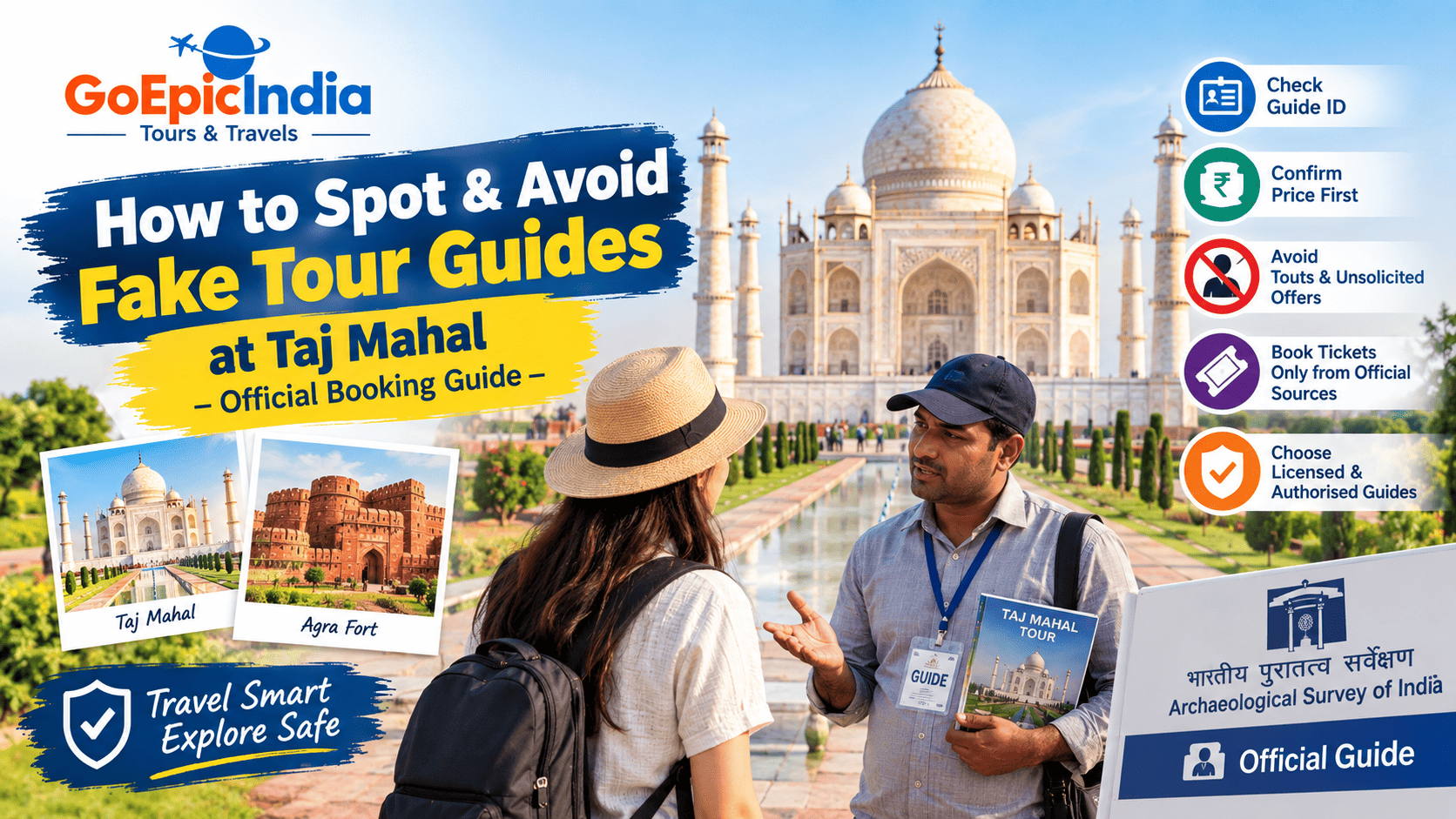
How to Spot & Avoid Fake Tour Guides at Taj Mahal – Official Booking Guide
This isn't just a minor tourist annoyance — fake guides at the Taj Mahal have ended up in actual police cases involving foreign diplomats. If it can catch VVIPs off guard, it can definitely catch a regular tourist off guard too. Here's how to make sure you're not one of them.
It's a Bigger Problem Than You'd Think
This isn't some rare, occasional scam. Over the years, there have been multiple documented cases of unauthorized guides slipping past security and accompanying high-profile visitors around the Taj Mahal and Fatehpur Sikri, without anyone realizing they weren't licensed.
US Navy Secretary Carlos Del Toro was escorted by an unlicensed guide during a 2022 visit, and a similar incident happened with the US Ambassador to India at Fatehpur Sikri. If unauthorized guides can slip past protocol for VVIP visits, you can imagine how easily they operate around everyday tourists who have no idea what an official guide is even supposed to look like.
Locally, these unlicensed guides are sometimes referred to as "lapkey" — and they're known for hovering around the entry gates, parking areas, and even hotel lobbies, offering to "help" before you've even had a chance to figure things out on your own.
How Fake Guides Actually Operate
It's rarely aggressive or obvious. Most of these guys work by approaching you before you even reach the ticket counter or entry gate, acting friendly and helpful, offering to "save you time" or get you a "special rate."
By the time you realize something's off, you've already paid for an overpriced, unofficial tour, or worse, been led to a shop that pays them a commission for bringing in tourists.
Some common patterns to watch out for:
- Someone approaching you unprompted near the parking lot or gate, claiming to be a "government guide".
- A driver or hotel offering a guide as part of a "package deal" without giving you a name, license number, or ID.
- Guides who can't produce an actual Ministry of Tourism license when asked.
- Guides who insist on taking you to specific shops for "authentic" marble or handicrafts after the tour.
That last one is a big red flag. Legitimate guides don't need to detour you through commission-based shopping stops to make their money.
How to Verify a Genuine Guide
The simplest test: ask for their license number. Every ASI or Ministry of Tourism-approved guide carries an official identity card with a photo and a license number printed on it. If someone hesitates, gets vague, or can't produce this, that's your answer right there — walk away.
Genuine guides are also listed with the local Tourist and Guide Welfare Association in Agra, and are trained to explain the actual history and architecture of the monuments accurately, not just a rehearsed sales pitch.
If a "guide" is more focused on getting you into a shop than answering your questions about the Taj Mahal itself, that's worth noticing too.
How to Book an Official Guide the Right Way
The safest approach is to book your guide in advance rather than deciding on the spot at the gate.
- Book through the ASI or a verified tour operator – Several licensed tour companies operating in Agra offer government-approved guides as part of their entry ticket packages. Look for ones that explicitly mention "government approved" or "Ministry of Tourism licensed" guides.
- Check for a license number in the booking confirmation – A legitimate booking will usually list the guide's credentials, or at least confirm they're an ASI-recognized guide.
- Avoid last-minute deals at the gate – This is exactly where most fake guides operate. If you haven't booked ahead, it's better to walk in without a guide than to risk hiring someone unverified on the spot.
- Ask your hotel for a referral, but verify independently – Some hotels genuinely do have contacts with real guides, but others push unlicensed ones because of a referral cut. Don't take a hotel's word alone — ask for the guide's ID and license number regardless.
Ticket Booking Scams Are a Related Risk Too
It's worth mentioning this alongside fake guides, since scammers often target the same tourists in both ways. In 2026, the ASI issued a public warning after discovering a fake website impersonating the official Taj Mahal ticket booking portal. Tickets bought through fraudulent sites don't work at the gate, leaving tourists stuck without entry.
To stay safe, only book tickets through:
- The official ASI ticketing portal.
- Verified payment gateways linked directly from ASI's own website.
- The official QR codes displayed at the monument or through verified tour operators.
If a link looks slightly off, has an unusual domain name, or was shared through a random social media ad, don't risk it.
What to Do If You Encounter a Suspicious Guide
If someone approaches you claiming to be an official guide and can't provide proper ID, it's completely fine to just say no and walk on.
You can also flag it to the tourist police stationed near the monument — Agra has a dedicated tourism police unit specifically because these issues are common enough to warrant one.
Reporting it isn't just protecting you; it helps crack down on the racket for the next tourist too.
Final Thoughts
A little bit of caution goes a long way here. Book your guide in advance through a verified source, always ask for a license number, and steer clear of anyone offering "special deals" right at the gate.
The Taj Mahal is impressive enough on its own — don't let a scam guide turn what should be a memorable visit into a frustrating one.